

Plot vs Mutual Fund: Compare Costs, Liquidity and Your Goals
A plot can fit someone who wants a specific property, can afford its full ownership cost and can accept a slower exit. Mutual funds can fit someone who wants scheme-based investing, smaller contributions and diversification without directly managing land. The right choice depends on the goal, investment horizon and risks you can carry.
A plot vs mutual fund comparison becomes misleading when it assumes every plot appreciates quickly or every mutual fund earns the same return. Both assumptions ignore what you actually buy.
For Nagpur buyers, start with two separate questions: do you want to own land for a future use, and does the purchase fit your overall finances?
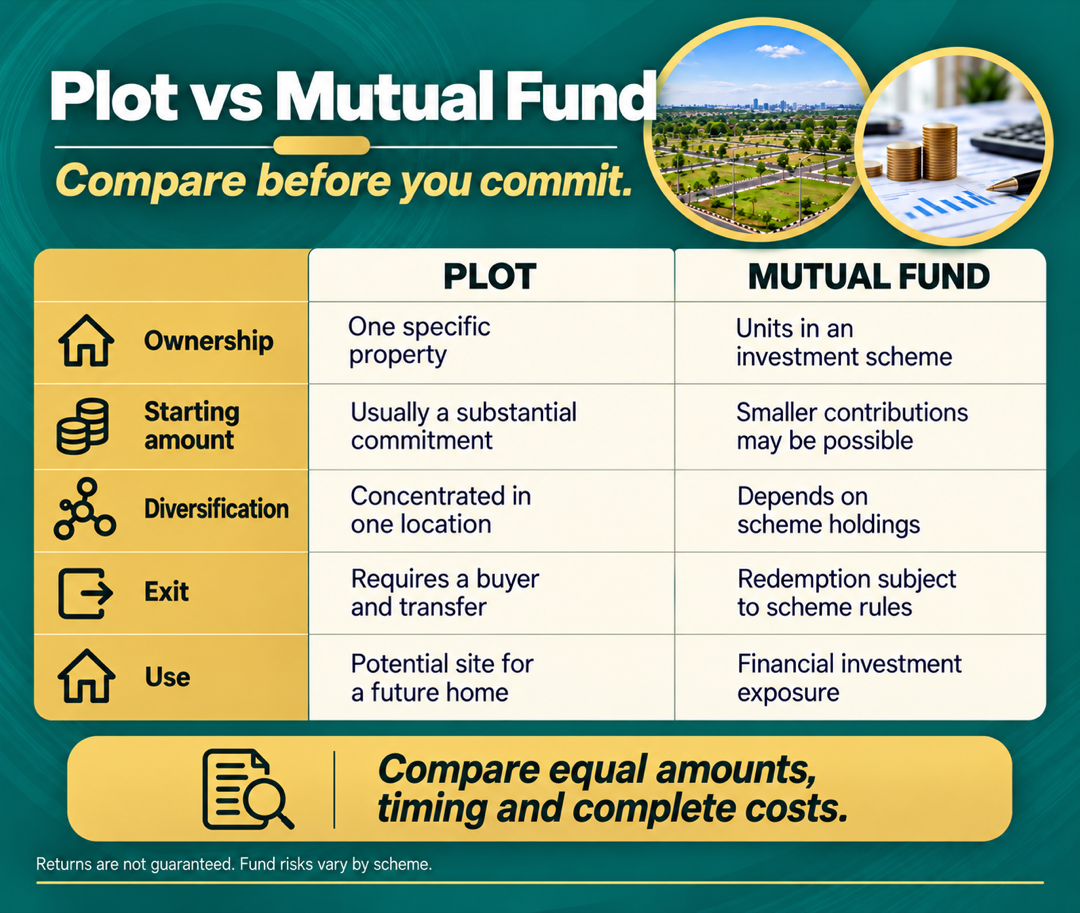
Plot vs mutual fund: the practical comparison
| Factor | Buying a plot | Investing in mutual funds |
|---|---|---|
| What you own | A particular property with a title and permitted use | Units in a scheme holding assets under a stated investment mandate |
| Starting amount | Usually the full transaction commitment, potentially supported by a loan | Many schemes permit smaller investments; minimums vary |
| Diversification | One plot concentrates exposure in one location | Depends on the scheme; diversified funds spread exposure, while narrow strategies can remain concentrated |
| Liquidity | A sale needs a buyer and completion of the property transaction | Open-ended schemes generally allow redemption, subject to scheme rules and settlement |
| Partial withdrawal | Selling part of a plot can be legally or practically difficult | Eligible units can generally be redeemed in part, subject to restrictions |
| Main expenses | Transaction, legal, holding and potential financing costs | Expense ratio, possible exit load, transaction costs and applicable taxes |
| Practical use | A future home or another approved use may be possible | Does not provide a site to build a home |
| Return certainty | Appreciation and resale are not guaranteed | Returns and principal are not guaranteed |
AMFI explains the advantages of mutual funds, including diversification and access to redemption in open-ended schemes. Liquidity still depends on the product: lock-ins, restrictions and settlement periods need to be checked.
Compare the actual fund category with the actual plot
“Mutual fund” is a broad category. Equity, debt, hybrid and other schemes invest differently and carry different risks. Even two equity schemes can have very different concentration and volatility.
AMFI’s scheme classification guide helps distinguish those categories. Read the scheme’s documents, costs and risk information before comparing it with property.
The same specificity matters for land. A plot’s approved use, access, surroundings, legal file and purchase price determine whether it deserves consideration. Two plots in the same city can have very different prospects.
For local context, consult Ozen’s Nagpur area-wise land price guide. Then compare actual plots using current, property-specific evidence.
When a plot may be the better fit
You want land for a future home
If the goal is a home in a particular location, owning a suitable plot can meet a practical need that fund units cannot. Check that the plot can support your intended building plan, and budget for construction separately.
Buying the land does not mean the future home is fully funded. Site preparation, approvals, services and building costs remain part of the plan.
You can manage concentrated ownership
A plot requires document storage, boundary oversight, payment of applicable charges and periodic attention to the site. You also need the financial capacity to hold it when buyer demand is weak.
Before paying a token, work through the legal checks for buying a plot in Nagpur. Legal review supports the purchase decision; it does not guarantee appreciation.
You have a realistic resale plan
Ask who would buy the property later and why. A future family buyer may value access and services, while another investor may focus on price and development prospects. Your exit assumption should match the actual plot.
Ozen’s plot resale guide can help you assess that buyer market before purchase.
When mutual funds may fit better
Scheme-based investing may suit someone building savings gradually, avoiding direct property management or keeping the option to redeem part of an eligible holding.
However, a monthly SIP is a contribution method, not a guarantee of returns. Market values can fall, and selling during a decline can realise a loss. AMFI’s risk guidance states that mutual funds are not assured-return products and can involve loss of principal.
Select a scheme around the goal and the time available. Do not assume an equity fund is suitable for money needed soon merely because redemption is possible.
Compare equivalent amounts and complete costs
A fair plot vs mutual fund comparison should use the same starting capital, contribution timing and evaluation period.
For example, comparing a ₹25 lakh plot purchase today with a ₹5,000 monthly SIP does not isolate investment performance. The amounts and timing differ. If comparing outcomes, account for all money invested and the dates it was committed.
For the plot, include acquisition charges, legal review, upkeep, selling expenses and financing costs. For the fund, account for investment expenses, any exit load and applicable taxes. Avoid double-counting scheme expenses already reflected in reported net asset value performance.
If you borrow to purchase the plot, evaluate the EMI obligation separately from expected appreciation. Use Ozen’s existing first-time plot buyer guide to organise your purchase budget, then obtain written lender terms for the shortlisted property.
Do you need to choose only one?
Not necessarily. A household may own a plot for a future home and hold financial investments for other goals. Whether that is affordable depends on income, existing assets, debts and accessible reserves.
Before committing, ask:
- Would this plot absorb too much of my accessible money?
- Can I meet costs if resale takes longer than expected?
- Do I understand the risks of the fund category I am comparing?
- Am I buying the plot for a genuine use or solely on a return promise?
- Have I kept enough money for near-term obligations?
If another property is part of your shortlist, read Ozen’s existing plot vs flat investment comparison. It examines a separate buying decision: purchasing land versus a completed residential unit.
Frequently asked questions
Turn the comparison into a property shortlist
If owning land fits your goal and budget, explore Ozen’s plots in Nagpur. Use the residential vs commercial land comparison to clarify the property’s intended use.
Contact Ozen Realtors to request a property shortlist, discuss the complete purchase cost and arrange a site visit. For allocation across property and mutual funds, seek advice suited to your full financial situation rather than treating a property seller’s recommendation as an investment plan.